TL;DR
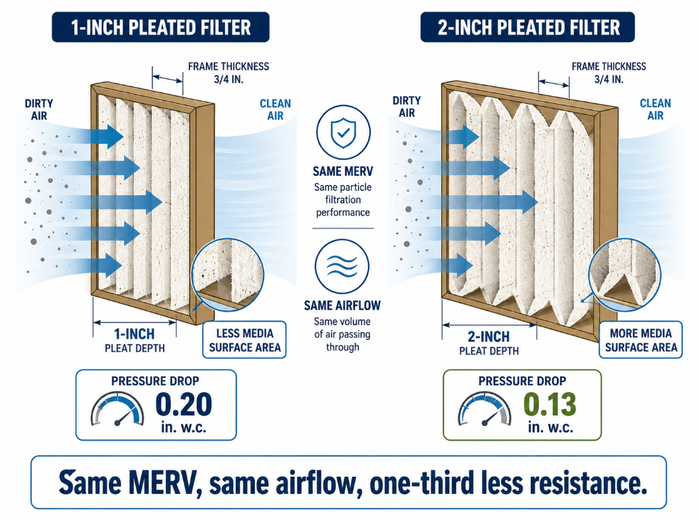
MERV 13 restricts airflow because of how much media the air must cross, not because of the rating itself. In Department of Energy test data, filters at identical MERV and airflow measured 0.20 in. w.c. of resistance at one inch and 0.13 at two inches, about a third less, purely from added pleat surface area. That gap is usually what keeps a MERV 13 upgrade inside a typical blower's budget. Measure your static pressure before and after the swap.
Key Takeaways
• Most residential air handlers are rated near 0.50 in. w.c. TESP; the filter's share is about 20%.
• MERV describes capture efficiency, not resistance. Media area drives pressure drop.
• At 300 fpm, a 2-inch filter measured 0.13 in. w.c. against 0.20 for a 1-inch at equal MERV.
• Four inches gained almost nothing over two. The first depth step matters most.
• MERV 13 captures at least 50% of 0.3 to 1.0 µm particles; MERV 11 captures 20%.
• Newer ECM blowers face more risk from restriction than older PSC blowers.
• Published resistance is the clean figure. Loaded resistance climbs, so leave headroom.
• Bypass can undo the upgrade and produces no symptoms.
What This Page Adds That Other MERV Guides Don't
Most filter articles say higher MERV means more restriction and stop there. We ran the federal test data and found four things consumer coverage misses.
• Two inches captures nearly all the benefit. One inch to two removed about a third of the resistance. Two to four removed roughly eight percent more.
• The risk is inverted. Common advice warns high MERV endangers old systems. DOE data says the reverse: a PSC motor moves less air and survives, while a modern ECM strains to hold airflow and can burn out.
• The slot is the constraint, not the rating. DOE reports most ducted U.S. homes have filter boxes sized for a one-inch panel rated near MERV 2.
• Many homes fail the airflow test before MERV enters it. A common 16x25 at typical airflow already sits above DOE's preferred face velocity range.
Your Static Pressure Budget, and Where It Goes
Static pressure is the resistance your blower fights moving air through filters, coils, and ducts, measured in inches of water column. Most residential air handlers are rated at 0.50 in. w.c. total external static pressure (TESP), per ACHR News guidance from National Comfort Institute's David Richardson. DOE's Building America guide puts the efficient ceiling at 0.4 to 0.5 in. w.c.
That rating is a budget, and field guidance allocates all of it. On a 0.50 in. w.c. system:
• Filter: 20%, or 0.10 in. w.c.
• Indoor coil: 40%, or 0.20
• Supply duct: 20%, or 0.10
• Return duct: 20%, or 0.10
The filter is the smallest allocation but the only one you can change yourself, which is why it gets blamed for problems the ductwork caused. The coil is budgeted double, and DOE notes some modern coils exceed 0.20 while clean. If your coil is over, the filter's share was spent before you bought anything.
So the question is not whether MERV 13 is too much. It is how much pressure this filter gives up at your airflow.
Why Two-Inch Depth Lowers Resistance
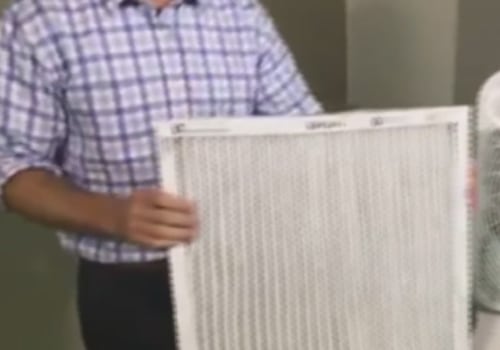
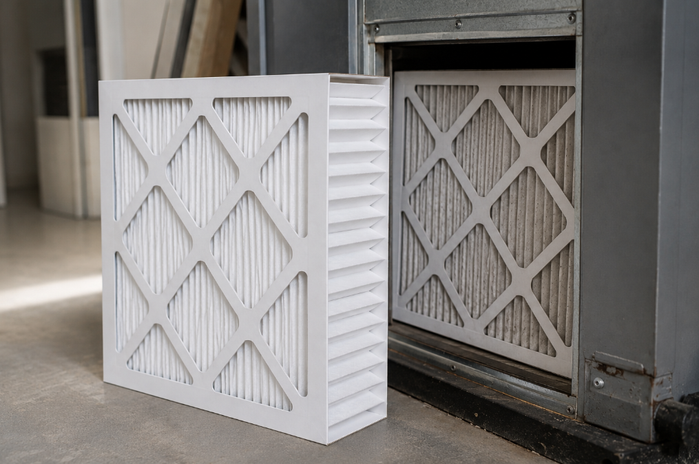
Depth lowers resistance by adding media surface area, which slows the air passing through it. DOE states the principle directly: a high MERV rating does not automatically mean higher pressure drop, because deeper or more numerous pleats reduce resistance without changing the rating.
Three MERV 7 filters from one manufacturer, tested at 300 fpm face velocity:
• 1-inch: 0.20 in. w.c.
• 2-inch: 0.13 in. w.c.
• 4-inch: 0.12 in. w.c.
The pattern is a sharply diminishing return. One inch to two removed about a third of the resistance. Two to four removed roughly eight percent more. That reframes the usual advice to go as deep as your system allows. Two inches does the structural work. Four inches mostly buys longer service intervals and usually needs a new cabinet.
“The depth decision people agonize over is really just one step. Get out of the one-inch slot and you have solved most of the airflow problem. Everything past two inches is a smaller argument about how often you want to change the filter.”
EPA's Indoor airPLUS filtration bulletin agrees, advising contractors to size filter boxes for thicker or wider filters because they create less static pressure.
Face Area Is the Second Lever
Face velocity is airflow divided by filter face area: cubic feet per minute (CFM) ÷ sq ft, expressed in feet per minute (fpm). A 16x25 filter has 2.78 sq ft, so 1,200 CFM produces about 430 fpm. A 20x25 at the same airflow drops to roughly 350 fpm. DOE puts the residential maximum at 500 fpm and prefers 200 to 400, meaning that 16x25 is already running high before you touch the MERV rating.
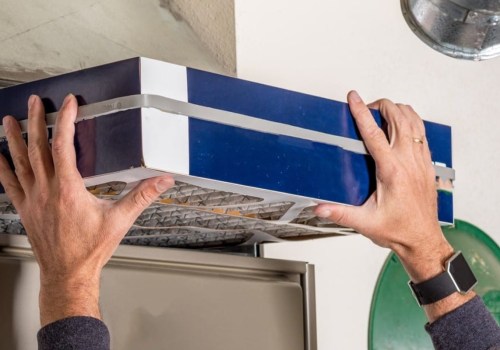
If your return rack accepts two inches, you already own the hardware. Two-inch air filters are stocked in most common face dimensions, so the upgrade is usually a filter change rather than a duct modification. See also 16x25x2 installation and care.
MERV 13 vs MERV 11 in a Two-Inch Filter
MERV 13 earns its added resistance in the submicron range, where it captures more than twice what MERV 11 does. Per the EPA's MERV reference, MERV 13 captures at least 50% of particles in the 0.30 to 1.0 µm range, 85% at 1.0 to 3.0, and 90% at 3.0 to 10. MERV 11 is rated at only 20% in that smallest band, where smoke and combustion particles live. EPA recommends at least MERV 13, or the highest rating your fan and filter slot allow.
Where MERV 11 still wins: systems already at or above their rated static pressure, undersized return ducts, or single-return homes at high face velocity.
Motor type matters more than most homeowners expect, and the conventional framing has it backwards. DOE describes a PSC blower falling off past roughly 0.5 in. w.c., moving less air but surviving, while an ECM increases speed and torque to hold target CFM and can burn itself out. Newer variable-speed equipment has less margin, and the failure is quieter because airflow never drops enough to warn you. Compare what MERV 13 captures against MERV 11.
Published Pressure Drop Is a Starting Number, Not a Fixed One
Every resistance figure on a filter label is its initial pressure drop, measured clean. It is the best that filter will ever perform. DOE distinguishes it from final pressure drop, the resistance once media is loaded, and notes that higher-MERV filters reach it faster because they capture more.
1. Budget headroom. A filter measuring exactly at your 20% allocation when clean is over budget a month later.
2. Loaded high-MERV filters can fail physically. DOE cites clogging and collapse as more likely with high-MERV media. On ECM systems, an over-loaded filter can be deformed or pulled into the duct, leaving the system unfiltered.
3. Depth buys time, not just airflow. More media area means a slower climb from initial to final resistance.
Do not ask whether a filter fits your budget on day one. Ask whether it still fits on day sixty.
If Your Rack Is Two Inches, You Already Have the Hardware
For most homeowners, running MERV 13 safely is a depth-and-dimension problem rather than a filtration problem. A two-inch filter spreads the same airflow across more pleat surface than a one-inch equivalent, which keeps pressure drop inside a typical 0.50 in. w.c. budget. Availability is wider than most homeowners assume. Filterbuy's two-inch catalog alone lists roughly 170 face dimensions, from standard sizes like 16x25x2 and 20x25x2 through odd racks such as 12.75x21x2 and 16.38x21.38x2, plus custom fabrication.
About Filterbuy: Filterbuy is an American air filter manufacturer headquartered in Talladega, Alabama, producing pleated residential HVAC filters across MERV 8, MERV 11, and MERV 13 ratings, including two-inch depths and made-to-order custom sizes.
Verify It on Your Own System in Four Steps
1. Find your rated TESP on the air handler data plate. Ratings vary, so 0.6 means something different on a 0.7-rated unit than a 0.5-rated one.
2. Take a baseline TESP reading with a manometer, supply plus return, at design fan speed with a clean filter. Manufacturers rate air handlers inconsistently, so ACHR recommends treating the filter as an external component.
3. Check published initial resistance at your approximate CFM before buying. California has required MERV, particle size efficiency, and pressure drop on filter labels since April 1, 2019, so the data exists even if your shelf omits it. Avoid manufacturers who will not provide it.
4. Re-measure after the swap. If filter pressure drop exceeds roughly 20% of your budget, increase face dimensions or move to a deeper rack rather than lowering MERV.
Filter Bypass Beats Every Other Variable
Bypass is air traveling around the filter instead of through it, and it can undo the entire upgrade. Air follows least resistance, so an edge gap takes a disproportionate share of the flow. A gapped MERV 13 can underperform a sealed MERV 8. EPA says the filter must fit snugly and never be bent or crushed to fit; Indoor airPLUS tells contractors to seal the slot so no path exists around it.
1. Check nominal versus actual size. A “16x25x2” typically measures about 15.5 x 24.5 inches. Most racks use the nominal convention, though not all, which is why manufacturers stock true-size variants. Filterbuy lists 15.5x24.5x2 and 16x25x2 as separate products. If your filter rattles or slides, measure before reordering.
2. Check the slot cover. DOE advises it fit tightly, but never be taped or caulked shut.
Bypass is invisible. Restriction announces itself through comfort complaints; bypass produces a system that looks fine while filtering a fraction of what you paid for.
Essential Resources
1. Filterbuy, Two Inch Air Filters – Confirm your rack size exists in two-inch depth.
2. DOE Building America, High-MERV Filters – The depth resistance comparison, face-velocity ranges, and PSC versus ECM behavior.
3. EPA, Guide to Air Cleaners in the Home – Fit requirements, thickness range, and replacement intervals.
4. EPA, What Is a MERV Rating? – The efficiency table across all three particle-size bands.
5. EPA Indoor airPLUS, Filtration Bulletin – Design guidance stating thicker filters create less static pressure.
6. ACHR News, Four Essential Static Pressure Readings – The measurement procedure and the 20% filter budget rule.
7. NAFA, Understanding MERV (ASHRAE 52.2-2025) – How the test works and what MERV-A reveals over time.
Supporting Statistics
1. Most U.S. filter slots were never sized for high-MERV media. DOE reports 68% of existing U.S. homes run ducted central heating, 77.1 million of 114 million, and that the vast majority have filter boxes undersized for thicker filters. (DOE Building America Top Innovations)
2. Bench testing: MERV 8 carried up to 4.7× the pressure drop of fiberglass. DOE's ARBI team tested 13 filters spanning MERV 6 to 13 against a MERV 2 baseline at multiple face velocities. New MERV 8 filters showed 2.7 to 4.7 times the pressure drop. PSC motors lost about 7% airflow; ECM motors held airflow but drew about 9% more fan power. (Same source)
3. Airflow problems alone cost up to 15% of system efficiency. ENERGY STAR lists blower airflow as an annual check-up item and puts the penalty at up to 15%. (ENERGY STAR Maintenance Checklist)
Why it matters: EPA reports Americans spend roughly 90% of their time indoors, where some pollutant concentrations run 2 to 5 times outdoor levels. That is the case for solving the airflow problem rather than settling for a lower rating.
Next Step
Pull your air handler's data plate rating, then have a technician take a TESP reading at design fan speed. That single number tells you whether MERV 13 is an upgrade or a restriction in your home.
Frequently Asked Questions
Does MERV 13 restrict airflow in a two-inch filter?
It adds resistance, generally within a healthy system's budget. Two-inch depth spreads airflow across more media than one inch, which is what keeps the pressure drop manageable. Measure your TESP to confirm.
Is MERV 13 safe for a residential blower?
For most systems at or under their rated TESP, yes, at two-inch depth or greater. Systems already running high static pressure will feel it, and that is a ductwork problem the filter exposes.
Does pressure drop stay the same as the filter loads?
No. Published figures are initial resistance, measured clean. Resistance climbs as media loads, and higher-MERV filters load faster.
Why does my filter fit loosely if I bought the right size?
Dimensions are nominal. A 16x25x2 usually measures about 15.5 x 24.5 inches. If yours slides noticeably, your rack may need a true-size filter, since air leaking around the edges bypasses the media.
How often should a two-inch MERV 13 filter be changed?
Inspect monthly at first to learn your home's loading rate, then set a schedule from that. See how often to change a MERV filter.
Can I use a one-inch MERV 13 instead?
You can, but you give up the surface area advantage and land at higher resistance. If your rack takes two inches, use two.
Glossary
Air bypass: Air that travels around the edges of a filter instead of passing through the filter media. Gaps, incorrect sizing, or a poorly sealed filter slot can reduce filtration effectiveness.
Airflow: The volume of air moving through an HVAC system, commonly measured in cubic feet per minute (CFM). Filter resistance, duct design, blower performance, and filter size can all affect airflow.
FPM (Feet per Minute): A measurement of air velocity. In this article, fpm is used to describe how quickly air travels through the face of an HVAC filter.
Initial pressure drop: The resistance created by a new, clean filter. Published manufacturer pressure-drop figures typically represent this initial condition rather than the resistance of a loaded filter.
Manometer: A pressure-measuring instrument technicians use to check static pressure and pressure differences within an HVAC system.
MERV (Minimum Efficiency Reporting Value): A filter rating that describes particle-capture efficiency across specific particle-size ranges. A higher MERV rating indicates greater filtration efficiency but does not by itself determine pressure drop.
Learn more about HVAC Care from one of our HVAC solutions branches…
Filterbuy HVAC Solutions - West Palm Beach FL
1655 Palm Beach Lakes Blvd., Ste 1005 West Palm Beach, FL 33401
(561) 448-3760
https://maps.app.goo.gl/VarpgNZnxuPQuW8A7