Don't take your indoor air for granted. The MERV number you pick for that 12.75x21x4 slot decides which particles stay out of your lungs, and which ones sail right through. Most homeowners underestimate the gap. After more than a decade manufacturing home air filters for millions of households, we can tell you exactly what separates MERV 11 from MERV 13 in your size. Here's a quick refresh on how any air filter does its job, then the side-by-side.
TL;DR Quick Answers
Best for most homes: MERV 11 in 12.75x21x4. Strong everyday filtration that keeps airflow where your HVAC system wants it.
Best for allergies, asthma, pets, or smoke: MERV 13 in 12.75x21x4. Captures down to 0.3 microns.
Biggest myth: "Higher MERV is always better." Only true if your HVAC system can handle the extra resistance.
Replacement cadence: Every 6 to 12 months in a 4-inch depth.
Rule of thumb: Modern system plus sensitive household, go MERV 13. Older system or standard home, MERV 11.
Top Takeaways
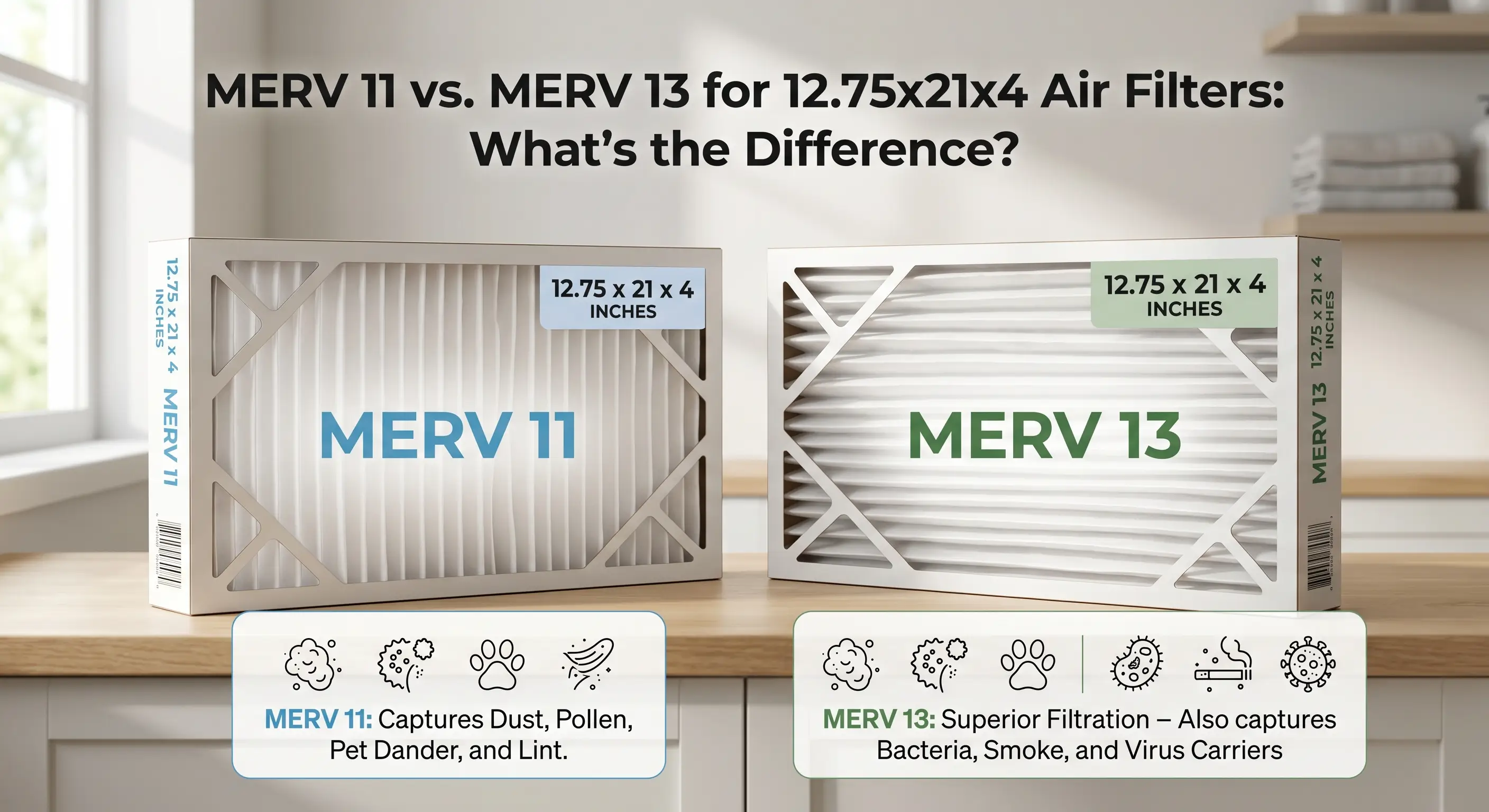
Same slot, different jobs: MERV 11 and MERV 13 both fit 12.75x21x4. They catch different particle sizes.
MERV 11 is everyday protection for pollen, household dust, pet dander, mold spores, and dust mite debris.
MERV 13 is upgraded protection for allergies, asthma, pets, smoke, and the fine particles down to 0.3 microns that MERV 11 can miss.
The 4-inch depth is your friend: it minimizes the airflow trade-off at higher MERV ratings, and it comes in many different filter sizes.
Always check HVAC compatibility before jumping to MERV 13, especially on older systems.
Change every 6 to 12 months: the pros will tell you to change air filter on a calendar reminder, not when you happen to remember.
What Actually Changes Between MERV 11 and MERV 13
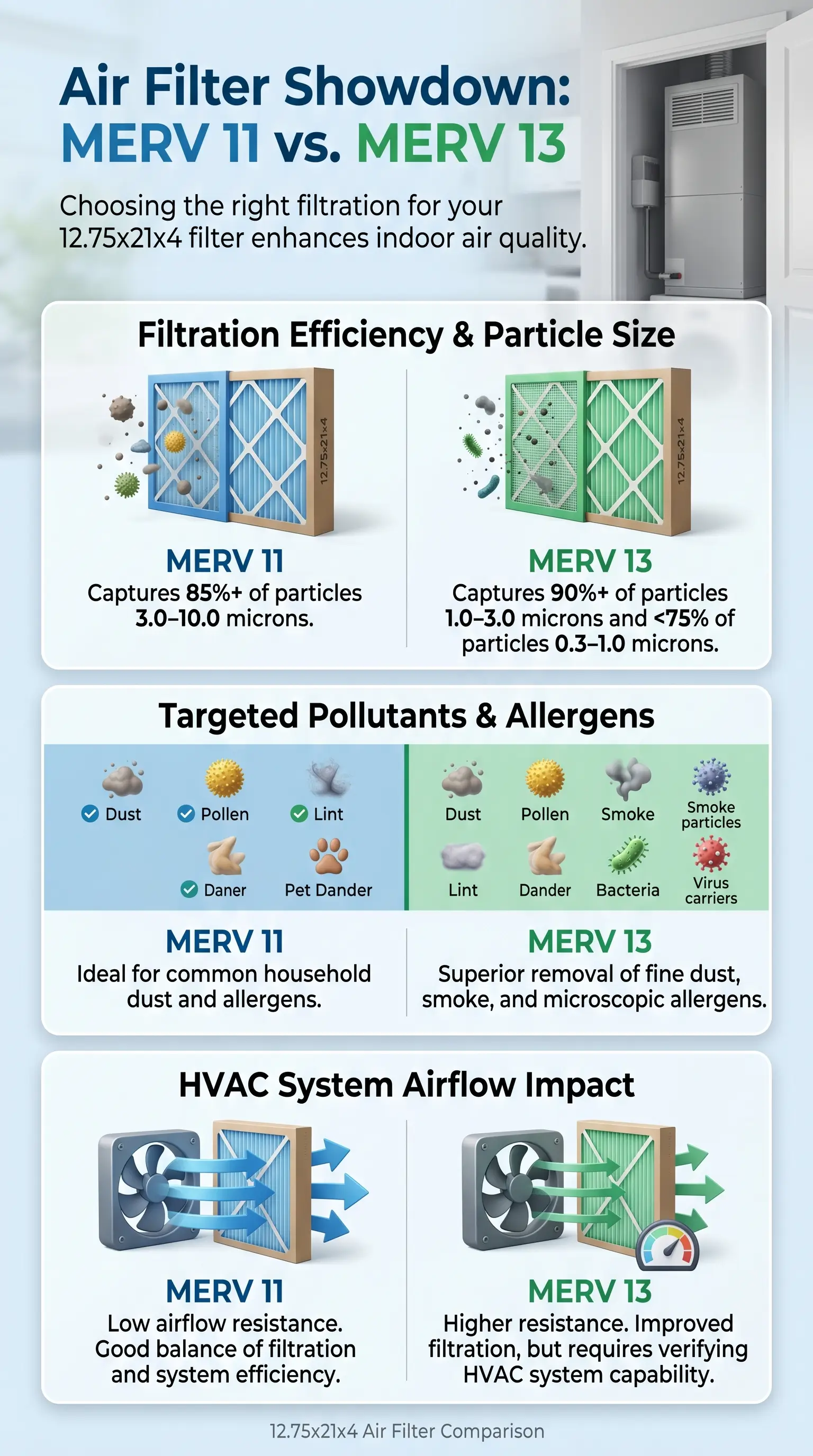
Both ratings fit the same 12.75x21x4 slot. Both are deep-pleated 4-inch pleated furnace filters that last longer and breathe easier than 1-inch options. The actual difference comes down to particle size. Each rating traps a different range, which means each one protects a different kind of household best.
MERV 11 for Your 12.75x21x4 Filter
MERV 11 catches particles from 1.0 to 3.0 microns. That range covers pollen, household dust, pet dander, mold spores, and dust mite debris, which accounts for most of what actually bothers people in a standard home. For households without heavy allergy or respiratory concerns, MERV 11 hits a practical sweet spot. It protects the HVAC system, cleans everyday contaminants, and keeps airflow strong. It also outperforms alternative setups like magnet filter systems on true particle capture.
Pro Tip: in our 4-inch depth, MERV 11 typically runs 6 to 12 months before it needs replacing. That's about four times the service life of a 1-inch MERV 11 filter.
MERV 13 for Your 12.75x21x4 Filter
MERV 13 catches everything MERV 11 catches, plus particles as small as 0.3 microns. That brings smoke, virus-carrying droplets, finer bacteria, and the micro-particles that trigger asthma and inflame sensitive immune systems into the capture range. If anyone in your home has allergies, asthma, a compromised immune system, pets with dander, or lives near wildfire smoke or heavy traffic, MERV 13 is the upgrade we'd recommend. It's also the rating we point households toward when they ask about virus protection filters.
One caveat we see constantly: older HVAC systems can struggle with the slightly higher resistance of MERV 13. Check your equipment manual before upgrading, or pick up a MERV 13 multi-pack so you can trial one filter and keep backups on hand.
Which One Is Right for Your Home?
Here's the honest answer from the people who build these filters. If your HVAC system is modern and anyone in your household has allergies, asthma, or breathes wildfire-prone air, go MERV 13. If you're about to replace aging equipment, price your options alongside AC installation cost estimates so you know what your new system can actually support. Either way, you can shop both ratings in your exact size at 12.75x21x4 Air Filters.
"After more than a decade manufacturing air filters across our U.S. factories, I can tell you the 4-inch 12.75x21x4 slot is one of the best HVAC configurations for stepping up your MERV rating. A MERV 13 in this depth captures finer particles than MERV 11 without the airflow penalty you'd see from the same jump in a 1-inch filter."
7 Essential Resources on Air Filtration and Indoor Air Quality
This shortlist comes from authoritative, non-commercial sources so you can verify everything we've said and go deeper on your own terms:
EPA — The Inside Story: A Guide to Indoor Air Quality. A plain-English overview of indoor pollutants and how filtration fits into the bigger picture. epa.gov/indoor-air-quality-iaq/inside-story-guide-indoor-air-quality
ASHRAE — The Organization Behind MERV. ASHRAE authors Standard 52.2, the test protocol that defines every MERV rating on the market. ashrae.org
CDC — National Asthma Data. Current U.S. asthma prevalence numbers and the case for why indoor air matters for respiratory health. cdc.gov/nchs/fastats/asthma.htm
American Lung Association — Indoor Air Quality. Clean-air guidance written for households managing respiratory conditions. lung.org/clean-air/indoor-air
NIEHS — Indoor Air Research. The National Institute of Environmental Health Sciences on how built environments affect long-term health. niehs.nih.gov/health/topics/agents/indoor-air
ENERGY STAR — Heating & Cooling Efficiency. Federal guidance on HVAC efficiency, filter care, and how filtration choices move your energy bill. energystar.gov/products/heating_cooling
AAFA — Asthma and Allergy Foundation of America. Certified guidance on allergen-reducing products and air quality strategies for sensitive households. aafa.org
3 Indoor Air Quality Statistics Every Homeowner Should Know
Americans spend about 90% of their time indoors, where pollutant concentrations can run 2 to 5 times higher than typical outdoor levels. Source: U.S. EPA
8.7% of U.S. adults currently have asthma (2024 National Health Interview Survey data), and indoor allergens are among the most common triggers. Source: CDC FastStats — Asthma
MERV ratings are tested across 12 particle-size ranges from 0.3 to 10 microns under ANSI/ASHRAE Standard 52.2. It's the only nationally standardized filtration rating in the U.S. Source: ASHRAE
Final Thoughts and Our Honest Opinion
Here's what we tell our own families when they ask. A 12.75x21x4 filter slot is one of the best HVAC configurations a home can have. Four inches of pleated media gives you room for serious filtration without choking your system. Waste that opportunity on a basic flat filter and you've left meaningful indoor-air improvement on the table.
Our honest opinion: most modern homes should default to MERV 13 in this size. The particle-capture upgrade from MERV 11 to MERV 13 is significant, the airflow penalty in a 4-inch depth is minimal on any HVAC system built in the last 15 years, and the health return for allergy-, asthma-, and smoke-exposed households is substantial. If you have an older system, work up to it. Start with a basic MERV 8 option or the MERV 8 dust defense options to baseline your airflow, then move up to MERV 11 or 13. For a deeper look at how HVAC-compatible filters get engineered, this third-party furnace filter guide is a useful next read.
One thing most homeowners overlook: the air filter isn't the only airflow point in the house. Pairing filter upgrades with dryer vent cleaning and regular duct care compounds the benefit. Whole-home air quality is a system, not a single product.
Frequently Asked Questions
Is MERV 13 too restrictive for a residential HVAC system?
Not for most modern systems. In a 4-inch depth like 12.75x21x4, the pressure drop is modest. It's far less than what you'd see jumping MERV ratings in a thin 1-inch pleated AC filter. If your HVAC equipment is 15 or more years old, or if you've noticed weaker airflow lately, check your owner's manual or call an HVAC tech before upgrading.
How often should I replace a 12.75x21x4 MERV 11 or MERV 13 filter?
Every 6 to 12 months for most households. Shift toward 6 months if you have pets, allergies, smokers in the house, or live in a wildfire-prone area. For a size-by-size breakdown of filter change frequency, third-party HVAC sources agree on the 6-to-12-month window for 4-inch and 5-inch depths.
Does MERV 13 filter out viruses?
MERV 13 captures many virus-carrying droplets and particles down to 0.3 microns. That said, no HVAC filter replaces ventilation, vaccination, or medical-grade filtration. It's one meaningful layer of defense — not a cure.
Will MERV 13 raise my energy bill?
In a 4-inch filter, the energy impact is minimal on a compatible system. Keeping the filter clean matters more than the rating itself. A loaded filter at any MERV rating costs you airflow and money. Some homeowners look at washable filter options, but most washables max out at MERV 4 to 8 and can't match a pleated MERV 11 or 13 on particle capture.
Is there a difference between MERV 11, MPR 1000, and FPR 7?
Roughly speaking, they're marketing equivalents, though MPR and FPR are proprietary systems from 3M and Home Depot. MERV is the only nationally standardized rating, tested under ASHRAE 52.2. That's why we quote it. When you're comparing online filter listings, translate every rating back to MERV so you're comparing apples to apples.
Ready to Breathe Easier?
You're the hero of your household when it comes to clean air. Whether you land on MERV 11 or MERV 13, shop your exact size at 12.75x21x4 Air Filters. You'll get it direct from our factory with free shipping and the Filterbuy satisfaction guarantee. Better air for your family starts with the filter you choose today.
Learn more about HVAC Care from one of our HVAC solutions branches…
Filterbuy HVAC Solutions - Miami FL - Air Conditioning Service
1300 S Miami Ave Apt 4806 Miami FL 33130
(305) 306-5027
https://maps.app.goo.gl/Ci1vrL596LhvXKU79